What factors affect the price of deep pour epoxy resin?
Deep pour epoxy resin is shining brightly in woodworking river tables, artistic castings, and thick-layer crafts, gaining increasing popularity. However, why is there such a large price difference in deep pour epoxy resin on the market? Some are as cheap as tens of yuan per kilogram, while others can sell for hundreds of yuan. In reality, the price of deep pour epoxy resin is not arbitrarily set, but is influenced by various factors. Understanding these factors can help you judge product value and make more rational and appropriate choices when purchasing.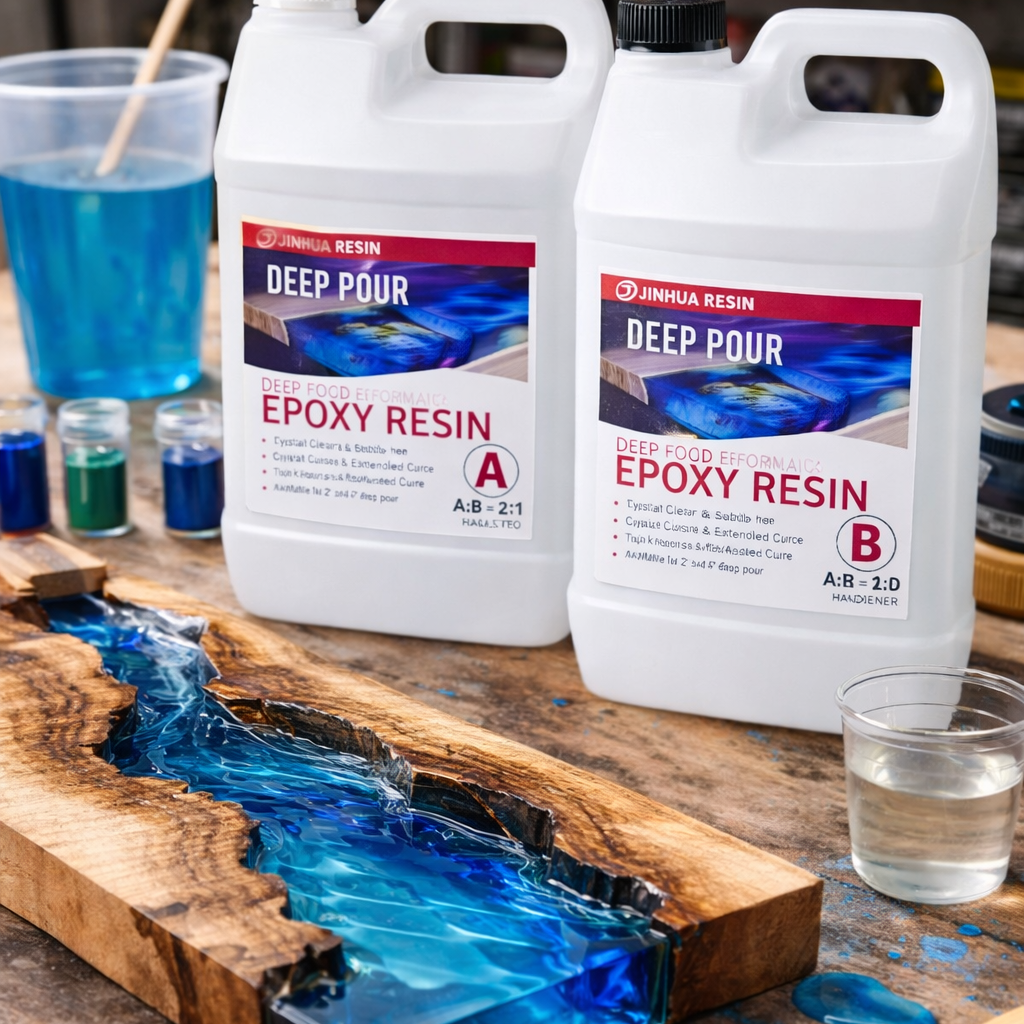
Secondly, product formulations and their differences lead to price fluctuations. Take deep pour epoxy resins and ordinary epoxy resins as examples. deep pour epoxy resins require slow curing and low heat release to avoid cracking and bubbling issues that occur during thick-layer casting. This places higher demands on production technology. Higher-priced products often have more sophisticated formulations, such as adding special additives to achieve natural degassing, UV resistance, and glass-like transparency after curing, making them suitable for high-end art pieces, precision industrial components, etc. Lower-priced products, on the other hand, have simpler formulations, potentially resulting in unstable curing speeds, yellowing, and cracking, making them more suitable for simpler filling projects with lower quality requirements.
Another factor determining the price of deep pour epoxy resins is the casting thickness. The biggest difference between deep pour epoxy resins and ordinary epoxy resins lies in the casting thickness. Ordinary coating-type epoxy resins can typically only be cast a few millimeters, while deep pour products can reach 8-12 inches. The greater the casting thickness, the higher the price. For example, a product capable of casting 2-4 inches in a single pass is typically 20% more expensive than one capable of casting less than 1 inch.
Market supply and demand also affect the price of deep pour epoxy resins. Like most chemical products, epoxy resin prices are influenced by market supply and demand. When downstream industry demand increases, such as in construction, electronics, electric vehicles, or wind power, the demand for epoxy resin increases, driving up prices; conversely, prices decrease.
Finally, brand influence matters. Well-known brands, having undergone long-term market testing, have mature formulas and stable quality, eliminating concerns about curing failures or substandard performance. Their prices are naturally higher than niche brands. Furthermore, these brands usually offer comprehensive after-sales service, such as specific mixing ratios, casting techniques, and solutions for curing abnormalities, which also contributes to the price. Conversely, while some niche brands may be cheaper, they lack comprehensive after-sales support. If problems arise, the customer has to bear the losses, potentially incurring higher costs. In summary, the price of deep pour epoxy resin is the final price resulting from the combined influence of various factors such as raw materials, quality, brand, and market supply and demand. We advise that when purchasing, you should not only consider the price, but also your own needs. A high price does not necessarily mean the best; "suitability" is "best."
Jinghua has been engaged in the research and sales of epoxy resins for 20 years, offering stable quality, high cost-performance, and a strong after-sales team. If you have any related needs, please feel free to contact us.